
JSA-01
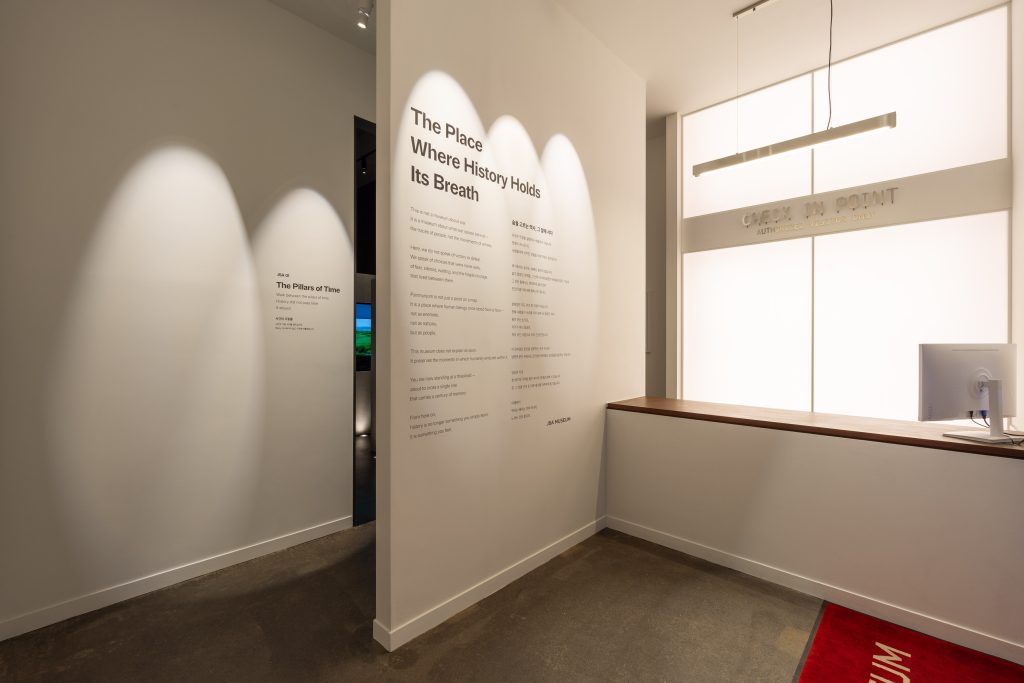
The Pillars of Time
THIS SPACE IS NOT A CONVENTIONAL EXHIBITION GALLERY.
HERE, TIME ITSELF BECOMES THE EXHIBIT.
- Home
- Experience
- JSA-01
On this Page
December 1950
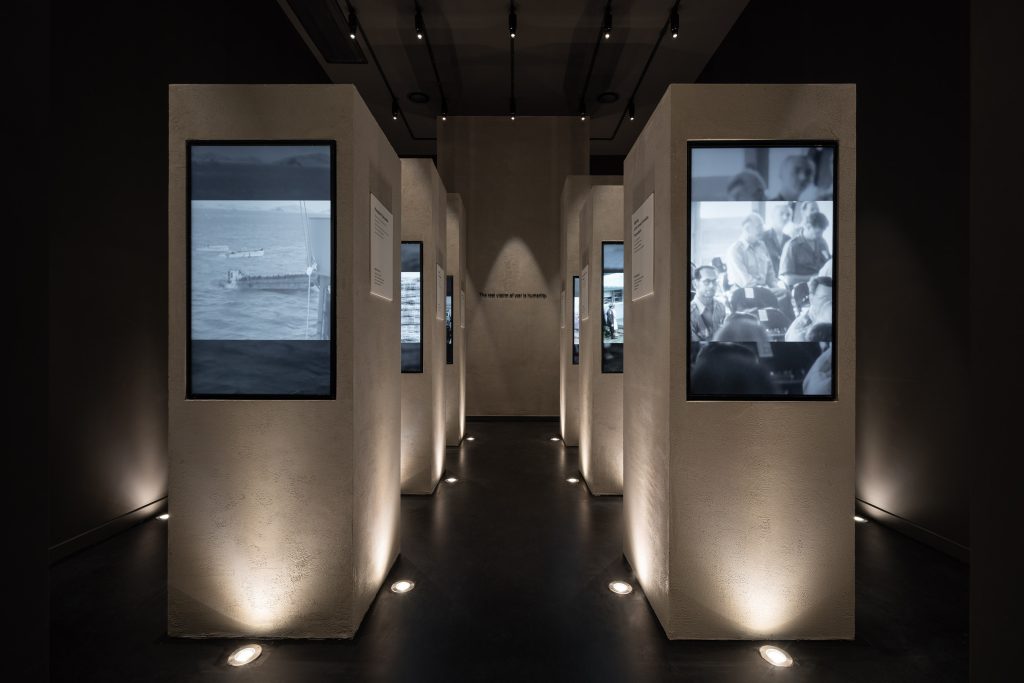
The Hungnam Evacuation
When the Sea Became the Last Hope
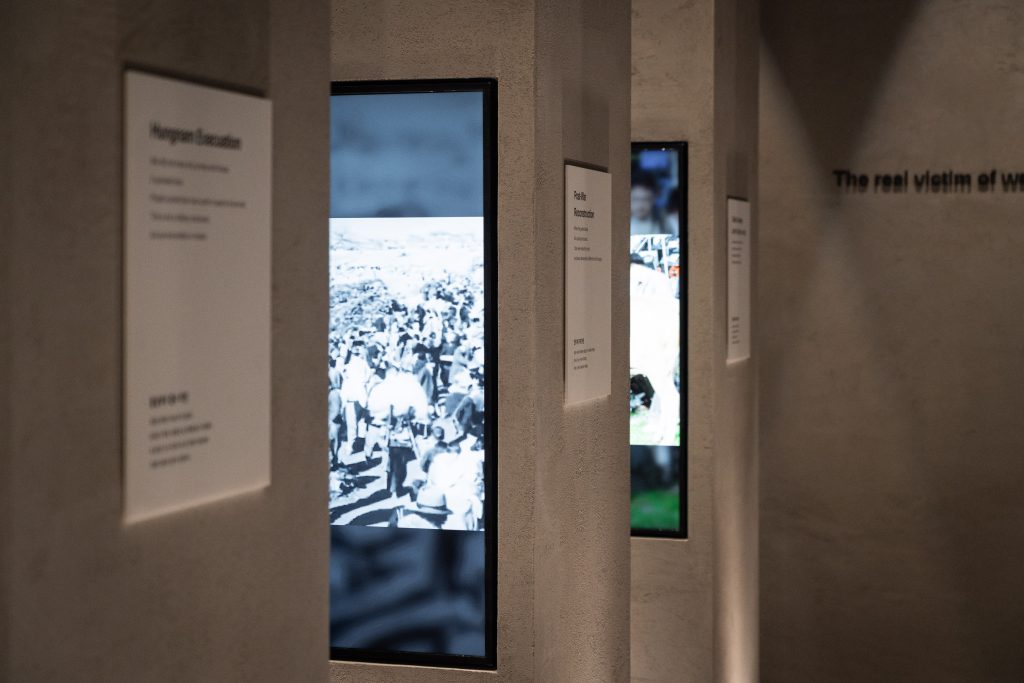
In the bitter cold of December 1950, more than 100,000 civilians gathered at the port of Hungnam, at the northern edge of the Korean Peninsula. There was nowhere left to run.
Just weeks earlier, the Chinese People’s Volunteer Army had entered the war in overwhelming force, driving United Nations and Republic of Korea troops into a desperate retreat southward. As the front collapsed, civilians surged toward the coast, knowing that to be left behind meant capture – or death.
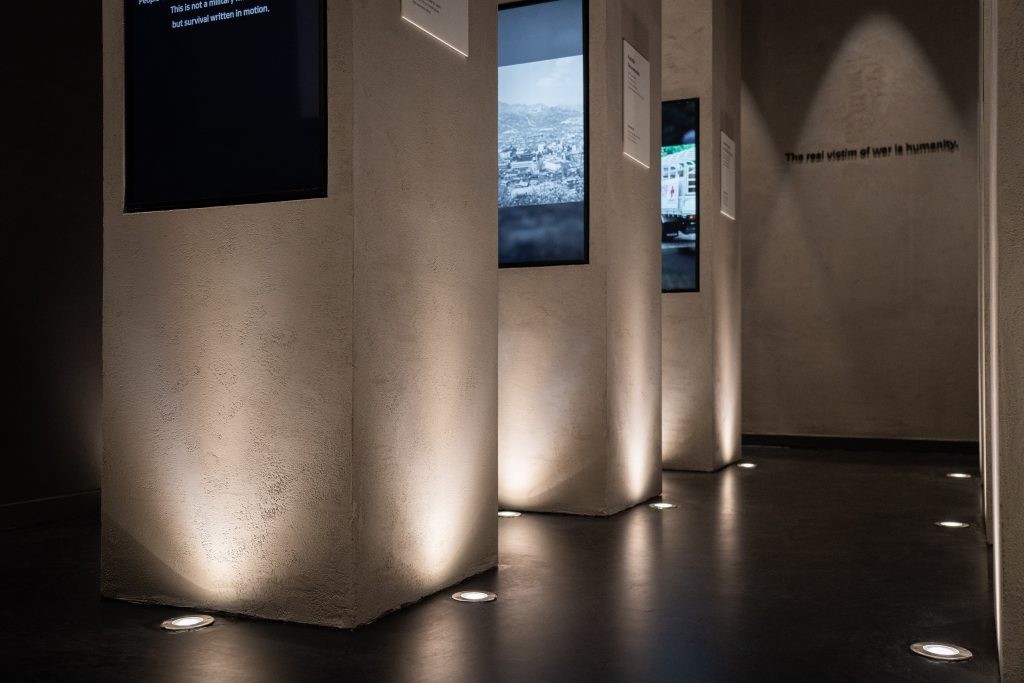
What you see in this footage is not an orderly military withdrawal.
It is survival.
Families carried everything they owned – blankets, cookware, and the small belongings of ordinary life – moving forward in a human tide pressed shoulder to shoulder with strangers. Children rode on backs. The elderly were guided step by step. No one looked back; nothing remained to return to.
Between December 14 and 24, 1950, the United States military coordinated one of the largest sea evacuations in history. Under the command of Major General Edward Almond, cargo ships, tankers, and even a commercial freighter – the SS Meredith Victory – took on passengers far beyond their intended capacity.
The Meredith Victory alone rescued 14,000 refugees in a single voyage. The ship carried no weapons, had no military escort. The SS Meredith Victory was designed to carry only 60 people. With 47 crew members already on board, the ship was originally able to take just 13 additional passengers. During the journey, five babies were born at sea. Not one life was lost.
In just ten days, 98,000 civilians were evacuated alongside 105,000 military personnel, 350,000 tons of cargo, and 17,500 vehicles.
The people seen here did not know whether the ships would carry them safely. They did not know their destination. They knew only one thing: the sea was their last chance.
July 27, 1953
The Armistice
The Pen That Stopped the Guns
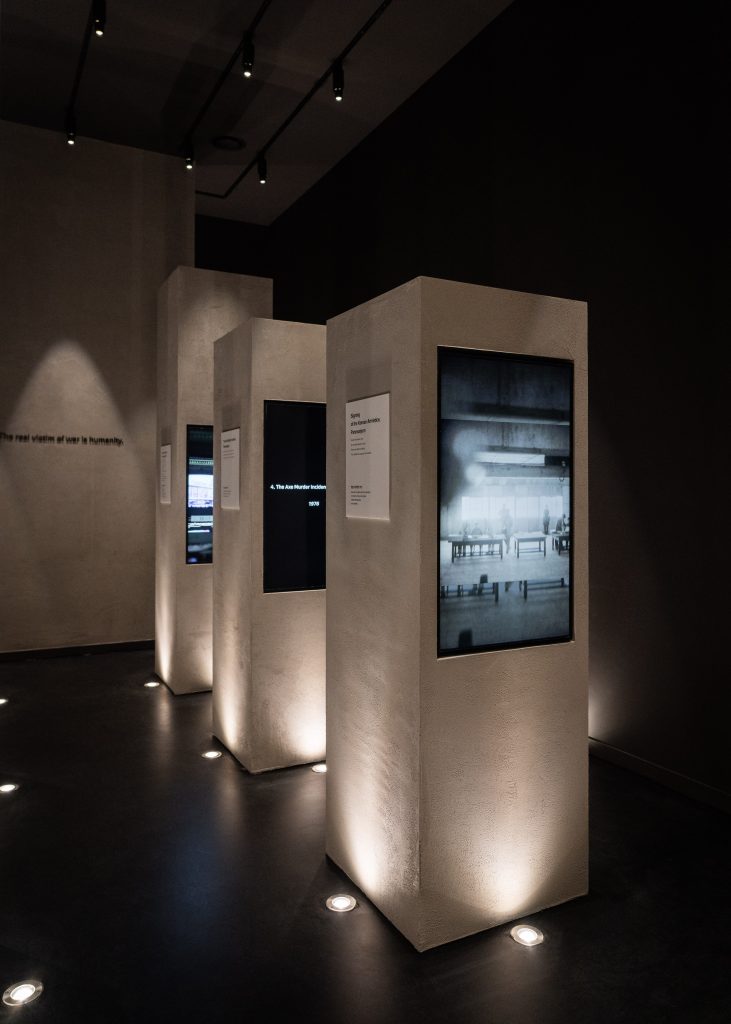
WHAT YOU SEE IN THIS FOOTAGE IS NOT VICTORY. IT IS NOT DEFEAT.
It is something more complicated — and perhaps more honest: an acknowledgment that after three years, one month, and two days of war, after more than 36,000 Americans, 137,000 South Koreans, and an estimated three million lives lost, the killing would stop. Not because the war had been won, but because it had to end.
Lieutenant General William Harrison signed for the United Nations Command. General Nam Il signed for North Korea and the Chinese People’s Volunteer Army. Twelve copies of the agreement were completed — six in English, three in Korean, and three in Chinese. The signing lasted twelve minutes. Neither man spoke. Neither looked up.
Journalists leaned forward behind their cameras. Generals sat with the stillness of men who had seen too much. Diplomats stood in measured silence. Outside, soldiers waited – veterans of trenches, frozen hillsides, and the mud of a peninsula most had never heard of before 1950.
The Korean Armistice Agreement did not end the Korean War. No peace treaty has ever been signed. The war continues to this day – held in suspension by an agreement intended to be temporary, pending a political settlement that never came.
The agreement established a ceasefire line running roughly along the 38th Parallel — almost exactly where the war had begun. Millions had died, and the border had barely moved. For now, the dying stopped.
THE EXCHANGE Coming Home
One of the most urgent provisions of the armistice was the return of prisoners of war. Operation Little Switch, in
April 1953, exchanged sick and wounded prisoners before the armistice was signed. It was followed by Operation Big Switch, beginning August 5, 1953 — the largest prisoner-of-war exchange in history.
Some men crossed the line under their own strength, heads raised and shoulders squared against the weight of years in captivity. Others were carried on stretchers, their bodies revealing what words could not. These were survivors not only of combat, but of imprisonment — hunger, cold, interrogation, and the long uncertainty of whether anyone was coming for them.
21,805 North Korean and Chinese prisoners chose repatriation. 7,862 refused to return — a deliberate and deeply consequential decision, witnessed and recorded before the world. On the United Nations side, 12,773 prisoners were returned, including 8,321 South Koreans and 3,597 Americans. Some had been held for more than three years. For families waiting at home, this footage became the answer to a prayer that had lasted 1,129 days.
The Rebuild
The War That Would Not End -
and the People Who Refused to Quit
The armistice was signed. The soldiers laid down their weapons. The guns fell silent. But for the people of Korea, the struggle did not end.
What you see in this footage is not simply reconstruction. The word feels too orderly, too administrative for what is happening here. This is something older and more fundamental – the human refusal to accept ruins as a final answer.
The war left behind a country that, by almost every measure, should not have survived. Seoul changed hands four times. Pyongyang lay in ruins. Villages across the peninsula were reduced to ash and broken stone. An estimated 600,000 homes had been destroyed. Schools stood hollow. Roads were scarred by craters. Hospitals had collapsed into rubble.
And yet – here they are.
Look closely at the hands in this footage. They are not the hands of machines or government programs. They belong to ordinary people – men, women, and children – lifting stone by stone, beam by beam, brick by brick.
They are not waiting to be rebuilt.
They are rebuilding.
In 1953, South Korea’s GDP per capita was approximately $67, among the lowest in the world. There were more ruins than buildings, more orphans than classrooms, more grief than language could contain.
What these people are building is not only walls, roads, or rooftops. They are building the country their children will inherit. They are laying the foundations of one of the most remarkable national transformations in modern history – what the world would later call the “Miracle on the Han River.”
“A nation is not rebuilt by those
who remember the past, but by those who refuse
to be buried in it.”
August 18, 1976
The Axe Murder Incident
A Tree.
A Blade.
A War That Never Ended.
It began with a tree.
A poplar tree stood in the Joint Security Area of Panmunjom — the narrow strip of land where soldiers of opposing armies stood within arm’s reach of each other every day, separated not by distance, but by a line. The tree had grown tall enough to obstruct the line of sight between UN checkpoints. On the morning of August 18, 1976, a work party of American and South Korean soldiers arrived to trim it. They did not finish.
North Korean soldiers, without warning and without provocation, attacked the unarmed work party with clubs — and with the very axes the crew had brought to prune the tree. Captain Arthur Bonifas was beaten to death. First Lieutenant Mark Barrett died of his injuries. Four American and five South Korean soldiers were wounded. Captain Bonifas was 30 years old. The world held its breath.
The United States raised its military alert to DEFCON 3 — the highest in decades. Carrier strike groups moved toward the peninsula. B-52 bombers flew in formation over South Korea. For a period of days, the possibility of a second Korean War was not theoretical. It was present, and it was close.
Three days later, in an operation called Paul Bunyan, a 813- man joint US-Korean force returned to that same tree — and cut it down. The stump was left in the ground. A statement. A boundary. A warning.
The incident was a reminder of what the DMZ has always been — not a peace, but a pause. Not a resolution, but a held breath. The most dangerous border on earth, where the armistice of 1953 is maintained not by trust, but by the daily presence of soldiers who understand that one wrong movement can restart everything.
The Visit
What a Son Inherits
Years later, a woman and a boy came to Panmunjom. They came quietly, without ceremony, without cameras
expecting them. Captain Bonifas’s wife and young son walked to the place where he had last stood – the place where an ordinary morning became the worst day of their lives – and they laid flowers.
Watch the boy.
He is young enough that the event which defines his family’s history happened before he could have understood it. He stands in a place of geopolitical gravity – a border that has shaped the fate of nations – and yet what he carries is something much simpler and much heavier than politics.
He is standing where his father died.
He looks at the stump.
That stump is all that physically remains of the event – the tree is gone, the soldiers have rotated, the diplomatic language has long since been exchanged. But the stump remains. Rooted. Unmoved. A scar in the ground that will not be smoothed over.
The Joint Security Area was built as a place for negotiation – for dialogue between sides that cannot otherwise speak. But on this day, it is something else. It is a grave without a grave marker. It is the place where a child learns, perhaps without words, what his father gave, and what was taken.
There is no age at which this loss becomes easier to hold.
June 1998
CHUNG JU-YUNG and The Cattle Crossing
Five Hundred Cows.
One Line. One Man’s Answer to History.
No government planned this. No treaty authorized it. No army was ordered forward.
In June 1998, Chung Ju-yung, founder of Hyundai and a native of what is now North Korea, loaded 500 cattle onto trucks and drove them north. Not through diplomacy. Not through trade negotiations. Through Panmunjom. Through this place.
The cattle crossed the same line that had divided a nation for nearly half a century – a line guarded by soldiers, defined by loss, and long believed uncrossable. For decades, families had stood on opposite sides unable to meet. In 1976, violence had erupted here over a single tree. And on this day, the crossing was made by cows.
Born in Tongchon, in what is now North Korea, in 1915, Chung had fled south as a young man, reportedly carrying money borrowed against his father’s cow.
The cattle he sent north, he said, were a debt repaid – fifty years late. Across a border that should not exist. But repaid.
At the time, North Korea was suffering a devastating famine known as the Arduous March. Hundreds of thousands, possibly millions, faced starvation.
The cattle were not merely symbolic. They were food. They were survival. Yet they meant something more.
In a place defined by military tension and political calculation, the most meaningful crossing of 1998 was made not by soldiers or statesmen, but by a civilian – and his cattle.
THE LINE CIVILIANS CROSSED FIRST
Later that year, Chung Ju-yung returned, driving 501 more cattle north.
In total, 1,001 cattle crossed the line. In Korean tradition, the number 1,001 signifies abundance – a gesture of giving more than required, more than expected.
In a place built for confrontation, he chose to bring something that needed feeding.
June 13, 2000
The PYONGYANG Summit
The Handshake Half a Century in the Making
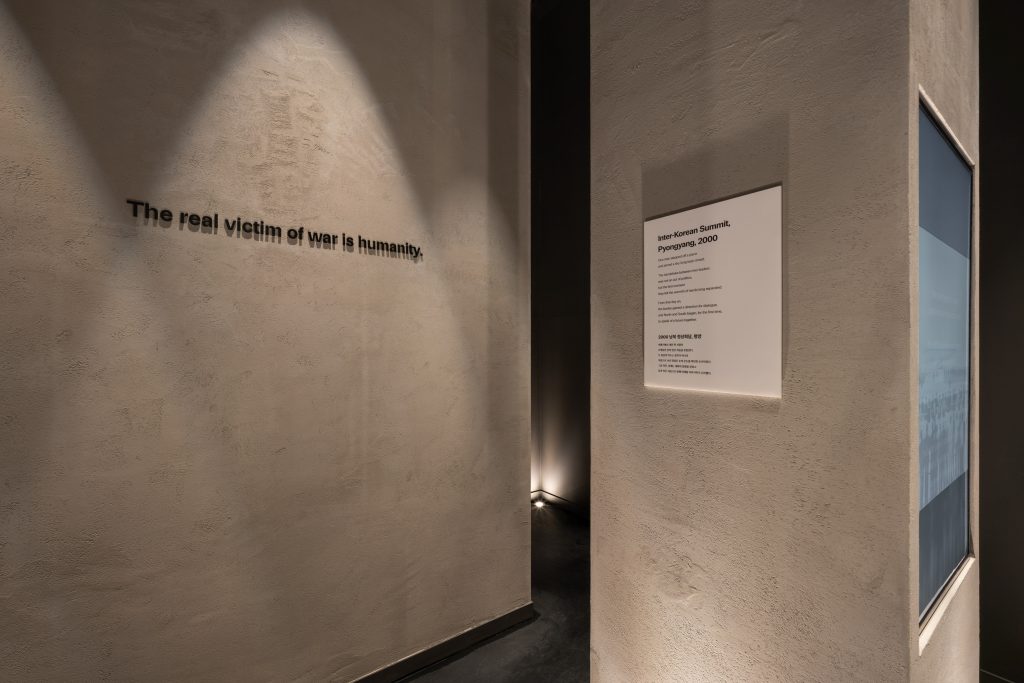
He stepped off the plane. And the other man was waiting. This had never happened before.
In the fifty-five years since the Korean Peninsula was divided – through war, armistice, decades of silence, suspicion, and moments when conflict seemed dangerously close – the leaders of North and South Korea had never met face to face. They had never stood in the same room. They had never spoken directly to one another.
On June 13, 2000, at Pyongyang’s Sunan Airport, President Kim Dae-jung of South Korea descended the steps of his aircraft.
Chairman Kim Jong-il of North Korea stood on the tarmac to greet him. He had come out personally.
Unscheduled. Unexpected.
The two men walked toward each other. And then they shook hands. Watch that moment carefully. Two leaders of same people, separated by the most militarized border on earth, closing half a century of distance with a single gesture.
This footage was filmed and broadcast by North Korean state television. The camera angles, the lighting, the deliberate framing reveal how Pyongyang chose to present this moment to its own citizens.
Even within that choreography, the moment remains extraordinary: a state that had long refused to acknowledge the legitimacy of the South now showing its leader smiling, welcoming, and extending his hand.
THE SUMMIT
What Was Said.
What Was Signed.
What It Meant
The talks that followed took place in the ornate formality of Pyongyang’s state reception halls. But watch the faces.
This is not Panmunjom in 1953, where generals signed an armistice in twelve minutes of silence without looking at each other.
Here, President Kim Dae-jung and Chairman Kim Jong-il speak openly, lean toward one another, and exchange words carrying the weight of half a century of division.
There are smiles – careful and political, yet unmistakably human – expressions few on either side had ever expected to witness.
On June 15, 2000, the two leaders signed the June 15 North–South Joint Declaration, a five-point agreement that, for the first time in official language, recognized reunification as a shared aspiration of both peoples. It committed both sides to humanitarian exchange, family reunions, and expanded economic cooperation.
It was not a peace treaty. It did not end the division.
But it marked the first time the two Koreas had reached a written agreement signed personally by their leaders, in the same room, by their own hands.
For families separated since the war — parents who had never seen their children again, siblings who had grown old on opposite sides of a line — this document carried profound meaning.
It was the first official acknowledgment that they had not been forgotten.
Later that same year, in October 2000, Kim Dae-jung received the Nobel Peace Prize, recognizing both this summit and the engagement policy known as the Sunshine Policy that made it possible.
The Room
That Still Answers
The Room That Still Answers
THE MOMENT YOU LIFT A RECEIVER,
YOU ARE CONNECTED TO THE SOUNDSCAPE OF WARTIME.