
JSA-02
The Room
That Still Answers
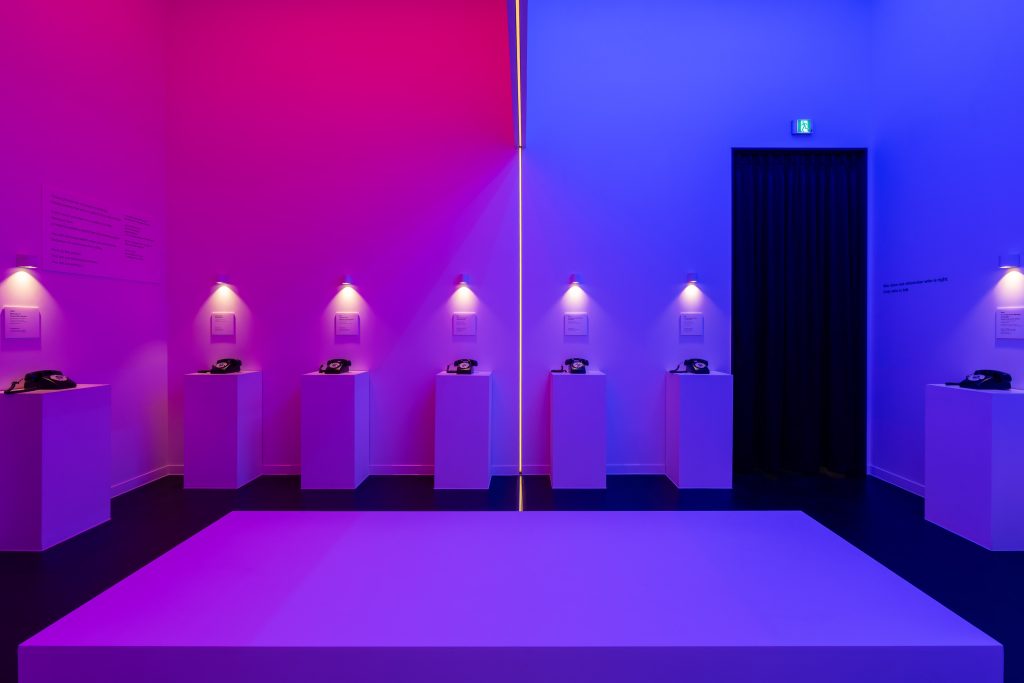
The Room That Still Answers
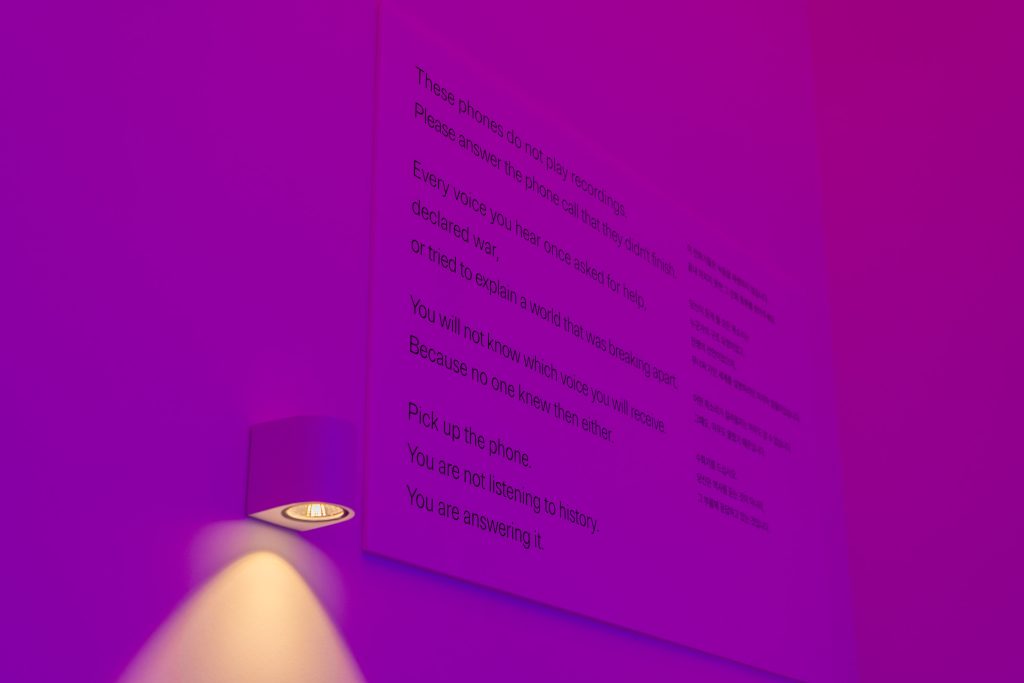
THE MOMENT YOU LIFT A RECEIVER,
YOU ARE CONNECTED TO THE SOUNDSCAPE OF WARTIME.
- Home
- Experience
- JSA-02
On this Page
1950
WAR ON THE AIRWAVES
When War Entered Everyday Life
Radio Announcement of the Korean War, 1950
In a radio studio in New York City, an ordinary broadcast was suddenly interrupted.
Moments earlier, the announcer had been speaking casually with listeners about everyday life. Then the tone changed — urgent, restrained, unmistakably tense.
Breaking news arrived: the Korean War had begun.
The broadcast captures the precise moment when war entered daily life without warning. Through the shift in voice and rhythm, listeners could hear fear, confusion, and the atmosphere of emergency spreading across distant airwaves.
It reminds us that wars do not begin only on battlefields — they begin in living rooms, through radios, in the instant when normal time abruptly collapses into history.
Kim Il Sung
Radio Address, 1950
Shortly after the outbreak of the Korean War, Kim Il-sung delivered an official radio address to the nation.Presented as a justification for military action, the speech framed the conflict as a necessary response against South Korea and the United States. Yet behind the rhetoric lay a deeper reality — the words themselves functioned as an extension of the battlefield.
Issued without a formal declaration of war, the invasion was accompanied by carefully constructed propaganda that sought to legitimize armed conflict. The broadcast suggests that the Korean War was not an accidental clash, but a conflict shaped by prior political intent and preparation. In this moment, language became indistinguishable from gunfire — a signal that the war had already begun.
1950
VOICES OF THE CONFLICT
The War Was Fought in Words, Too

Broadcast Announcing
the Capture of Seoul, 1950
During the early days of the Korean War, news of the fall of Seoul was broadcast across the North through state radio.
The announcement framed the occupation not as an invasion, but as a “liberation,” claiming that the city had been freed from American colonial control and the government of Syngman Rhee.
The broadcast’s triumphant language reveals how wartime propaganda transformed military advance into ideological victory, illustrating how radio became a powerful instrument for shaping public perception and legitimizing the war.
President TRUMAN addresses
The United Nations, 1950
In this address to the United Nations, President Harry S. Truman defined the Korean War as a confrontation between the free world and the communist bloc, explaining the legitimacy of deploying UN forces to Korea.
His words marked a decisive shift: the conflict was no longer seen as a regional war confined to the Korean Peninsula, but as a test of the postwar international order — a moment when the future balance of the world seemed to hinge on events unfolding in Korea.
1951-1953
TOWARD ARMISTICE
A War Moving from Guns to Negotiation
THE KOREAN CEASEFIRE TALKS BEGIN, 1951
This recording captures the real voice of the United Nations Command’s U.S. Army general who first called for armistice negotiations during the Korean War.
By 1951, the front lines had hardened into a deadly stalemate. Victory on the battlefield was no longer within reach, and the war began to shift from guns to diplomacy. Amid mounting casualties and rising global tensions, the proposal for talks marked a decisive turning point — the moment when the Korean War stopped moving toward victory and instead moved toward suspension.
Here begins the story of a war that never truly ended, but was paused by negotiation rather than peace.
EISENHOWER –
ON THE KOREAN ARMISTICE, 1953
In this address, President Dwight D. Eisenhower reflects on the Korean War and the prospect of an armistice, revealing growing concern over America’s strategic burden and the dangers of a prolonged conflict.
Rather than viewing the war solely as a military struggle, Eisenhower frames it as a challenge to the emerging international order — a moment when decisions made on the Korean Peninsula carried consequences far beyond the battlefield.
Kim Il Sung Address – July 1953
Following the signing of the Korean Armistice Agreement on July 27, 1953, Kim Il-sung delivered an official radio address to the nation. Although the fighting had ceased, the meaning of the war was immediately reinterpreted through the lens of state ideology.
In the speech, the outcome of the conflict was framed as a victory for North Korea, transforming a military stalemate into a political triumph. The guns had fallen silent, yet the narrative of war continued — carried forward not through battles, but through words, memory, and propaganda.
To this day, July 27 is commemorated in North Korea as “Victory Day,” where the armistice is remembered not as a pause in conflict, but as proof of national strength. The broadcast reveals how wars do not truly end at the negotiating table; they persist in interpretation, identity, and the stories nations choose to tell.
Yearless / War
THE INVISIBLE
AIR OF WAR
War Is Not Only Seen. It Is Heard.
WAR AMBIENT SOUND
THE INVISIBLE AIR OF WAR
Tension leaves its trace in sound. This audio installation is composed of authentic combat noise and military radio communications. Rather than documenting a single event, it immerses visitors in the atmosphere war creates — a space where uncertainty, vigilance, and fear become constant companions.
Through fragmented transmissions, distant movements, and unfinished voices, listeners encounter the invisible dimension of modern warfare. Here, war is not only seen; it is heard — lingering as tension in the air, revealing how violence can become normalized long before and long after the battlefield falls silent.
CAPTAIN JUNG’S FINAL RADIO CALL
This recording preserves the final radio transmission of Captain Jeong Tae gyeong during combat in the Vietnam War.
Surrounded by enemy forces, his voice carries urgency, responsibility, and an unwavering commitment to the soldiers under his command.
In his final message, he does not speak as an abstract symbol of war, but as an individual confronting fear, duty, and mortality at the same moment. His plea reflects a commander determined to protect his men and to meet the end with dignity rather than surrender.
The transmission allows visitors to encounter war not as a story of nations, but as a deeply human experience — where history is reduced to a single voice asking to live, to fight, and to remain honorable until the very last moment.
“…We are completely surrounded…
I can no longer maintain command… Please save us.
Give us the order to attack.
I do not want to sit here and die…
I refuse to be remembered as a cowardly commander.
I would rather fight and fall bravely
and with honor…”
Memory
VOICES
THAT REMAIN
When Private Memory Becomes Public
Finding Dispersed Families
– Live Broadcast
Scenes of families separated by war and division searching for one another through national broadcasts have been inscribed on the UNESCO Memory of the World Register.
Across television screens, people called out the names of parents, siblings, and children lost for decades, hoping that somewhere, someone was listening.
Beyond ideology or national borders, these broadcasts revealed the human cost of division – a collective memory shaped by absence, longing, and survival.
For families scattered by war, speaking a loved one’s name over the airwaves became an act of reunion, a miracle that restored fragments of time once thought forever lost.
For an entire nation, it was a moment shared in tears – when private grief became a public memory.
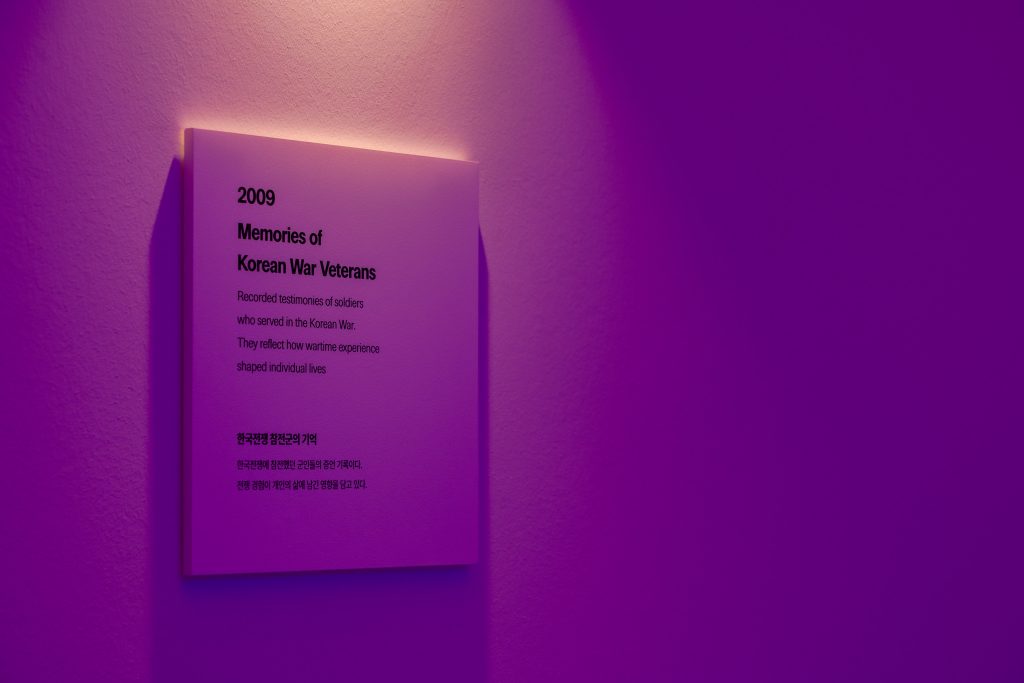
Memories of Korean War Veterans, 2009
Decades after the Korean War, former prisoners of war and detained soldiers return to Korea, revisiting places once marked by fear and survival.
Now elderly, they speak in quiet, reflective voices, recalling memories that time has never erased. Their testimonies reveal a different truth of war – that even after the guns fall silent, the conflict continues within individual lives. Carried through the voices of aging veterans, the fear and pain first felt in their youth remain vividly present, reminding us that war does not end when history declares it over.
1998
CROSSING THE LINE
Chairman Chung’s Cattle Crossing to North Korea

Chairman Chung’s Cattle Crossing to North Korea, 1998
On June 16, 1998, businessman Chung Ju-yung crossed the border into North Korea, leading a herd of cattle in an unprecedented journey north. More than an economic gesture, the event symbolized a civilian initiative toward reconciliation – a moment when private citizens and economic exchange reached across a divided peninsula before political agreements could follow.
The cattle drive became a powerful image of a changing era after the Cold War, suggesting that dialogue could begin not only through diplomacy, but through human connection, shared history, and practical cooperation.
2018
VOICES
ACROSS THE DIVIDE
VOICES ACROSS THE DIVIDE
One Peninsula. Different Voices. Shared Memory.

Mass Rally Song in Pyongyang, 2018
In Pyongyang, the voices of 150,000 citizens rise together in a mass chorus singing “Let Us Meet Again.”
The performance reveals a distinctive form of collective expression in North Korea, where political messaging and national emotion merge into a single public spectacle.
Themes of reunion and reunification are conveyed not only as political ideas, but as shared emotional experiences, demonstrating how large-scale performances become powerful instruments of state narrative and collective identity.
ARIRANG – North Korean Version
This is Arirang as performed and sung in North Korea. Though the melody remains familiar, its arrangement and performance reveal how the same song evolved differently within separate political systems.
Yet the emotion it carries transcends division. The song still resonates as a shared voice of the Korean people — a reminder of a time when the peninsula experienced a common cultural sentiment.
Reinterpreted in the North Korean style, Arirang demonstrates how one melody can be understood and used differently in a divided reality while continuing to preserve a cultural bond beyond political boundaries. It is a sound that symbolizes a national emotion and collective memory that division has never fully silenced.
2018–2019
THE LINE BECOMES
A MEETING PLACE
From Confrontation to Encounter

For a brief moment at the dividing line,
enemies worked side by side, 2018
At the Military Demarcation Line, North and South Korean forces jointly withdrew their Guard Posts (GPs).
Soldiers from both sides worked side by side, coordinating and verifying the dismantlement of positions that had long symbolized confrontation.
Representatives from the two Koreas greeted one another with a handshake, facing each other not with weapons raised, but carrying tools for dismantling the outposts.
This moment captures a rare transformation – when a space once defined by hostility briefly became a place of trust, cooperation, and reconciliation.
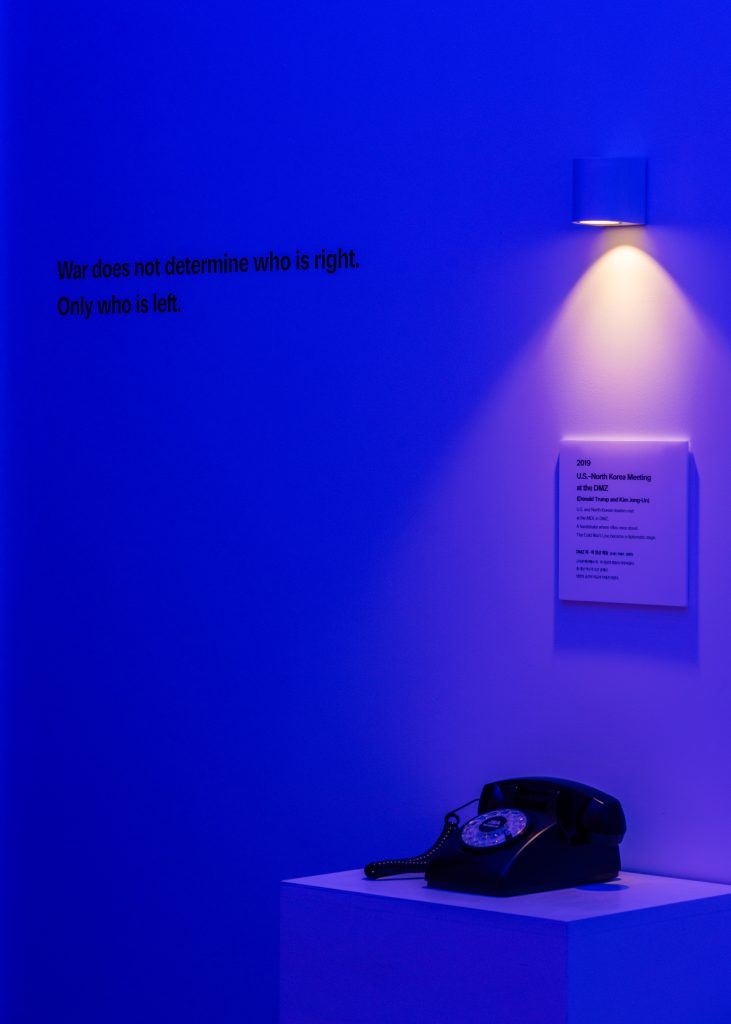
U.S.–NORTH KOREA MEETING
at the JSA Panmunjom, 2019
At the Military Demarcation Line in Panmunjom, voices once shaped by confrontation were replaced by conversation.
Here, the President of the United States, Donald Trump, and North Korea’s leader, Kim Jong-un, met face to face – transforming one of the Cold War’s most symbolic frontiers into a stage for diplomacy.
Standing at a line long defined by armed tension, President Trump greeted his counterpart:
“Good to see you again. I never expected to meet you at this place.”
Kim Jong-un replied with an invitation filled with historic meaning:
“If you take just one step forward, you will become the first U.S. president to set foot on our land.”
Moments later, Trump crossed the Military Demarcation Line, briefly stepping onto North Korean soil – an unprecedented act that turned a boundary of division into a gesture of dialogue. The meeting, arranged through an unexpected phone request and an immediate response from the North, unfolded with remarkable spontaneity.
For decades, the Korean Peninsula has appeared separated by an unbreakable barrier. Yet in this fleeting encounter, the border suggested another possibility – that peace and reconciliation may sometimes arrive not through long preparation, but in a single, unexpected step.
THE THRESHOLD OF NO MAP
A boundary perceived through
sensation rather than geography